
Construction surety tracking
Track sureties received from subcontractors and issued by the company’s bank with type, project, guarantor, amount, validity and release status.
Construction surety tracking: how it works in Home Builder Software
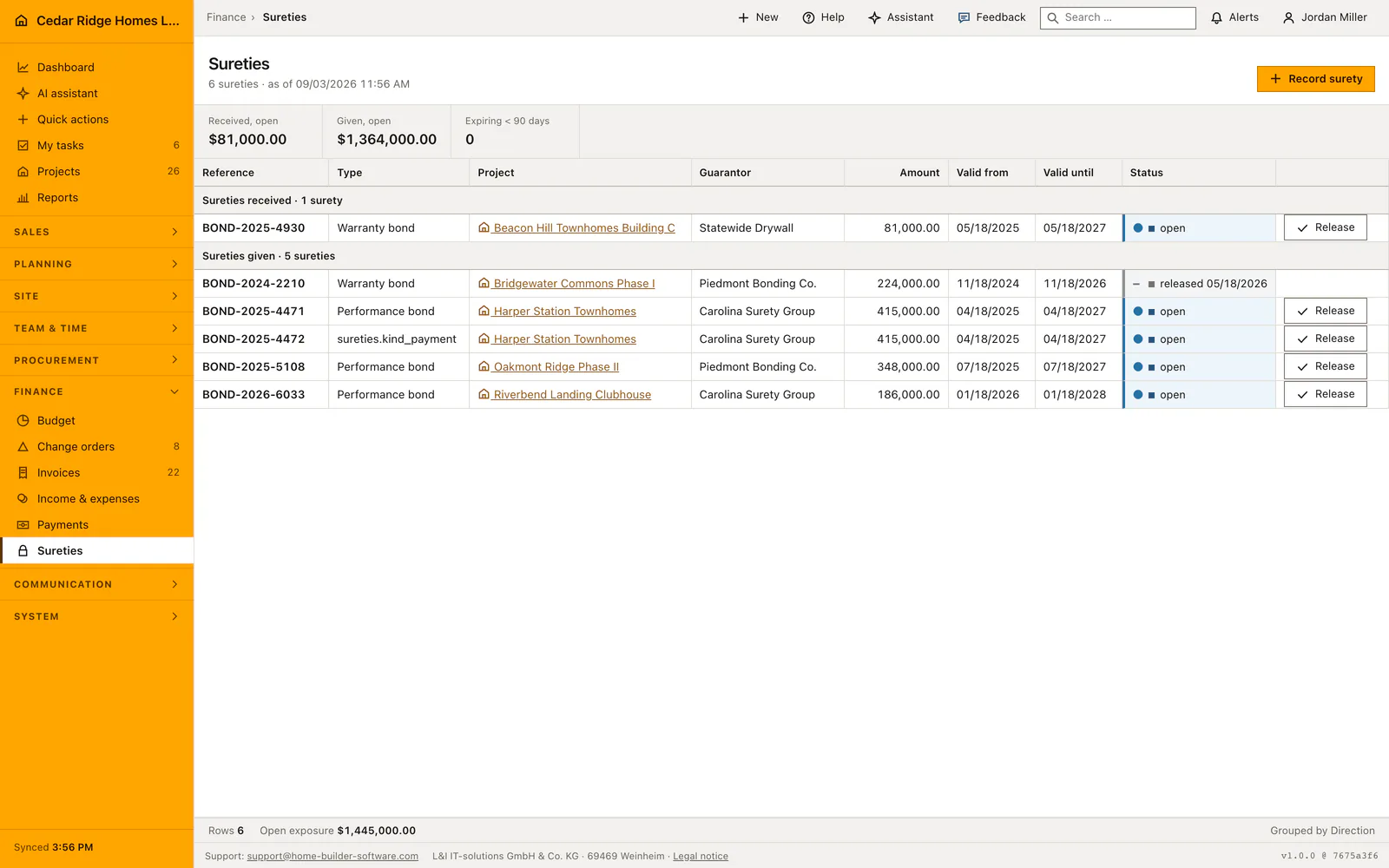
Sureties are money that is promised rather than paid, and they go missing in filing cabinets. This register keeps both directions in one place: instruments received from subcontractors and instruments the company bank has issued to customers. Received and issued exposure are summed separately, and a third figure counts the open instruments whose validity ends inside ninety days, tinted yellow as soon as there is one.
Each entry carries reference, type, project, guarantor, amount and a validity range where an empty end date means open-ended. Types cover performance guarantee, warranty guarantee and the §650f BGB builder security. The project is optional, since framework instruments belong to no single site. Rows group by direction and sort by expiry, and the status reads open, expiring on a date, or released on a date, in blue, yellow and gray.
Release is the moment that matters, and it is written once. The action stamps today as the release date only while that field is still empty, inside a locked transaction, so a double click can never overwrite an existing date and a released instrument cannot be released a second time. From that point the amount drops out of the exposure figures, and the closed row still shows when the security ran and against which project.
Recording a received or issued surety with reference and validity
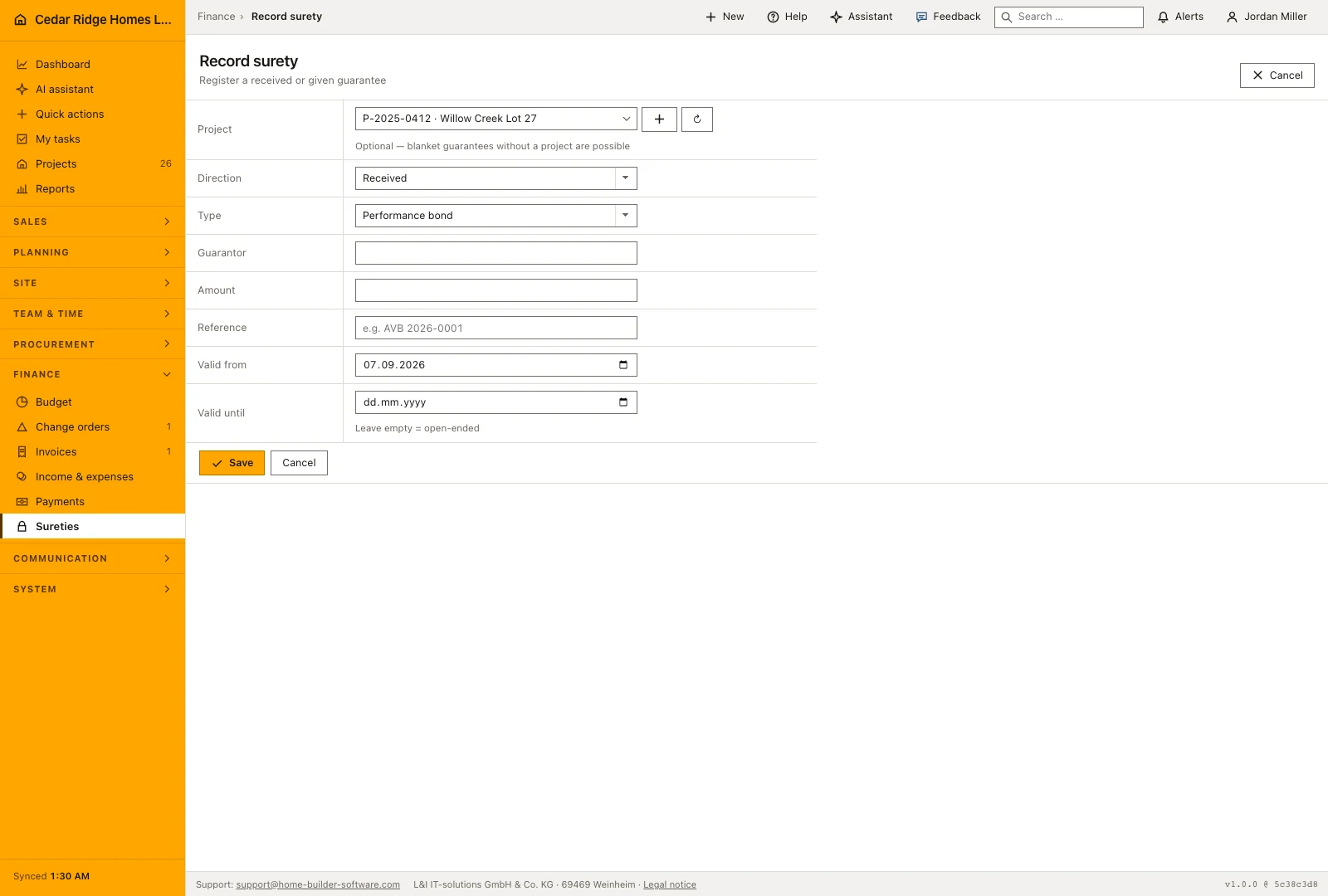
The capture form asks for project, direction, type, guarantor, amount, reference and the validity range. The guarantor is the bank or insurer that stands behind the paper and takes up to 150 characters. The amount has to be above zero. The reference is required and takes up to 100 characters; the placeholder shows the shape of a usual bond number, and it is what everybody searches for when the paper has to be found again.
Valid from defaults to today and valid until may stay empty, which records the instrument as open-ended. An end date must not fall before the start date, and the form refuses the combination rather than storing an impossible range. Saving returns to the register with a message naming the reference, and the new row appears inside its direction group.
 Open full-size screenshot
Reading exposure and the ninety-day expiry figure
Three figures head the register: the sum of open instruments received, the sum of open instruments given, and how many open instruments run out within ninety days. That third figure turns amber the moment it rises above zero and is the reason to open the page at all, because a performance bond has to be extended before it lapses rather than after.
Rows group by direction, received first and given below, and sort inside each group by end of validity, so the paper that expires next is near the top of its block. The status reads open, expires with the date, or released with the date. The status bar adds both exposure sums into one open exposure figure, and the project name in the row opens the job it belongs to.
Sureties, projects and the handover date behind a warranty bond
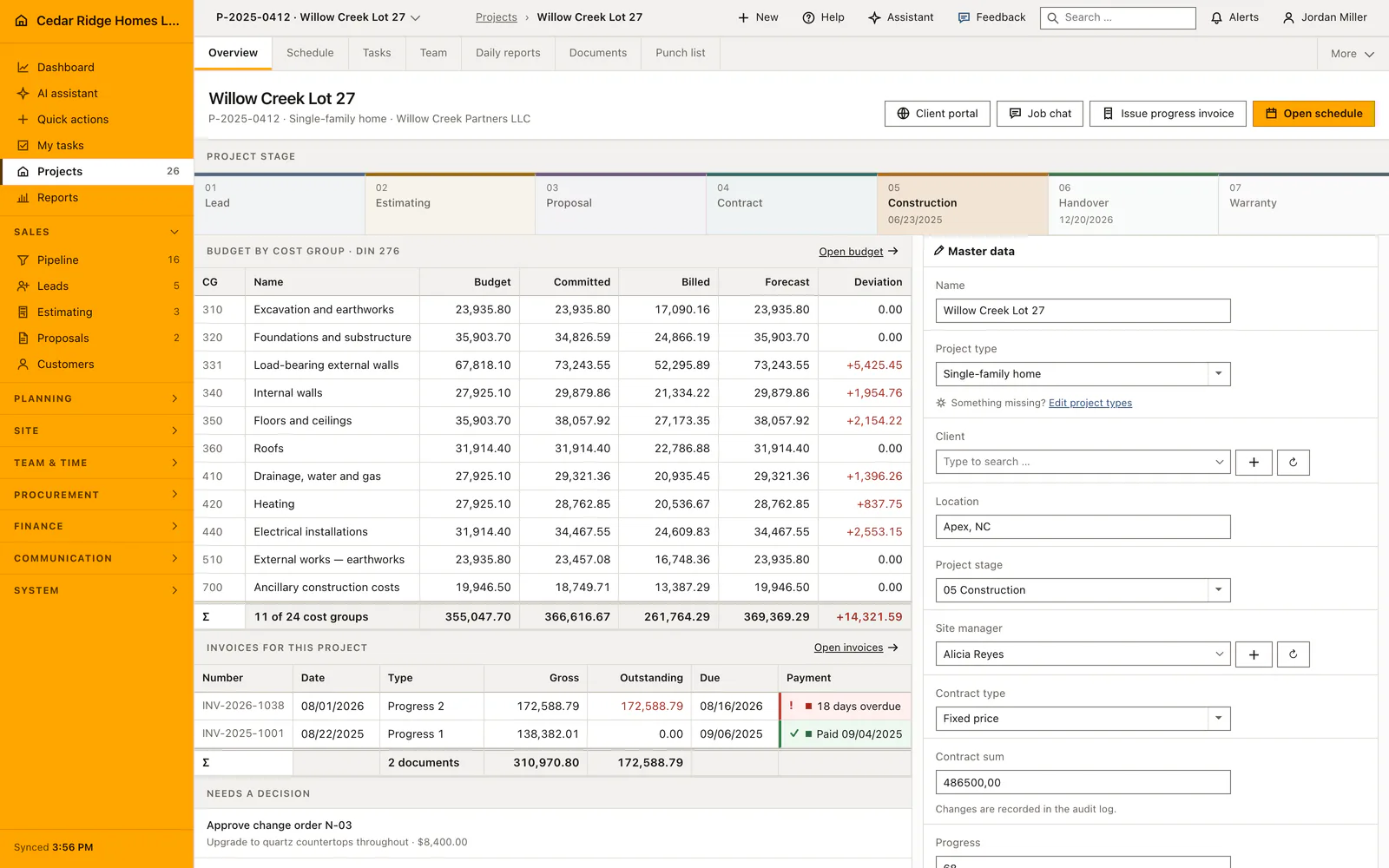
A surety with a project shows the job name as a link into the project file, and the file is where the dates that decide the validity live: the handover date and the warranty phase that follows it. A warranty bond is expected to outlast that period, which is why the register keeps the end date beside the amount rather than in a note.
Instruments received belong to the subcontract they secure, so the guarantor and the reference should match the paper filed with that contract. The company's own bank guarantees run the other way and tie up credit line until the release, which is what the given figure quantifies. Neither figure counts a released instrument, so the two sums answer what is bound today rather than what was ever issued.
 Open full-size screenshot
Construction surety tracking in the daily routine
Sureties usually arrive with a signed subcontract or come back from the bank, and the office records them the same day: direction, type, guarantor, amount, reference and validity. Commercial management reads the ninety-day figure when reviewing exposure, because a lapsing performance guarantee has to be extended before it runs out. At handover or after the warranty period, whoever closes the job releases the instrument in its row, and the exposure totals fall without a further posting.
Read the documentationConstruction surety tracking: what it covers
Separate received and issued open surety exposure
Highlight open instruments that expire within 90 days
Record release so the amount no longer counts toward exposure
Construction surety tracking: questions and answers
Can a surety exist without a project?
Yes. Framework sureties can be recorded without a project.
Can a released surety be released again?
No. The first release date closes the instrument for exposure calculations.
Use Construction surety tracking on your own projects
Request a trial period for the workflow around this module. We agree the roles, permissions and useful scope with you before preparing access.