
Construction purchase order software: setup and daily use
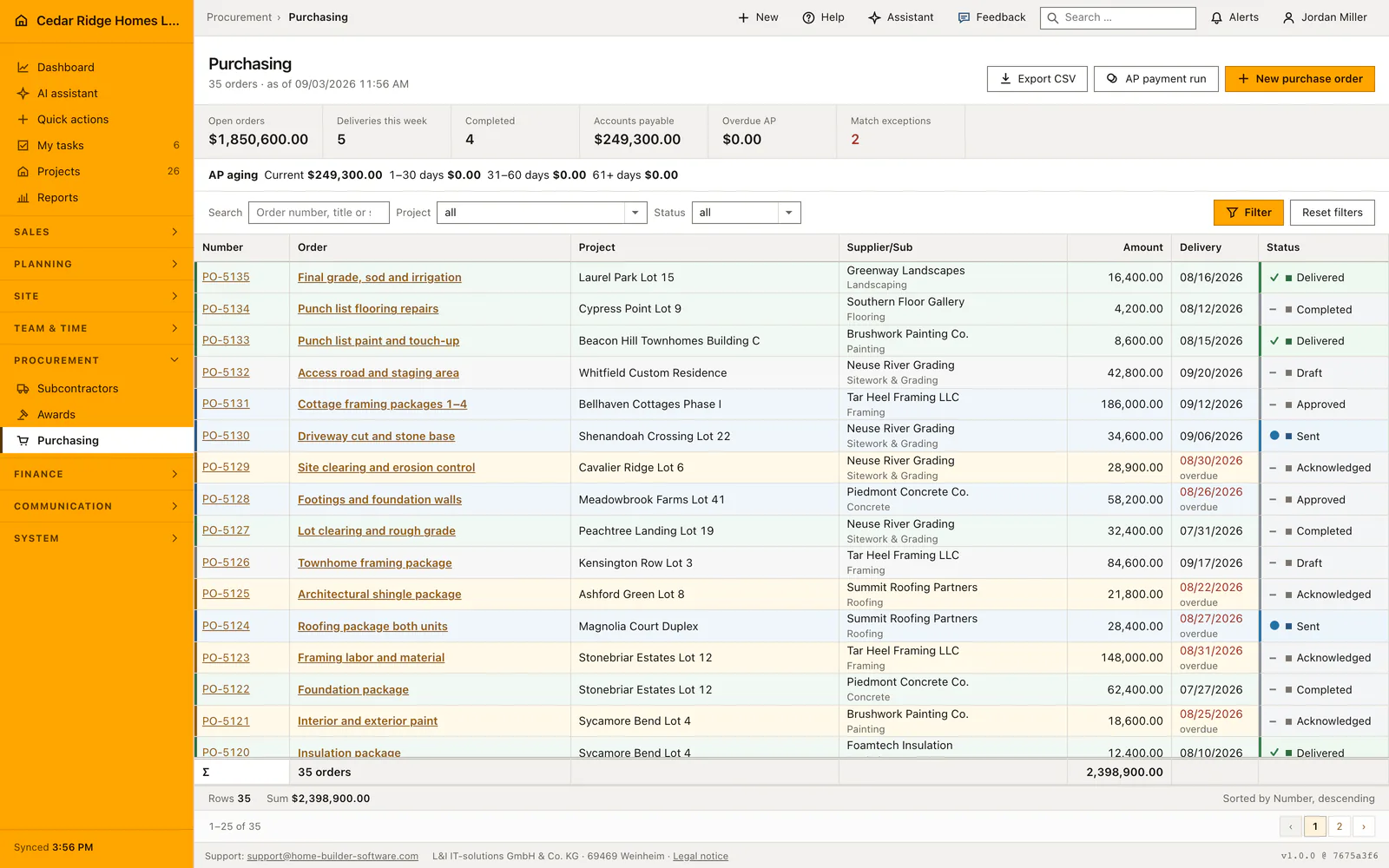
Purchasing is where every order to a supplier or subcontractor is written, tracked and paid. Open /purchasing, filter by project or status, and the table gives you number, title, project, supplier with trade, amount, delivery date and state. Writing an order needs the purchasing.manage right; reading the list needs finance.view. Line items turn a bare amount into something a delivery can be booked against and a supplier invoice checked against.
Supplier records and the purchasing.manage right
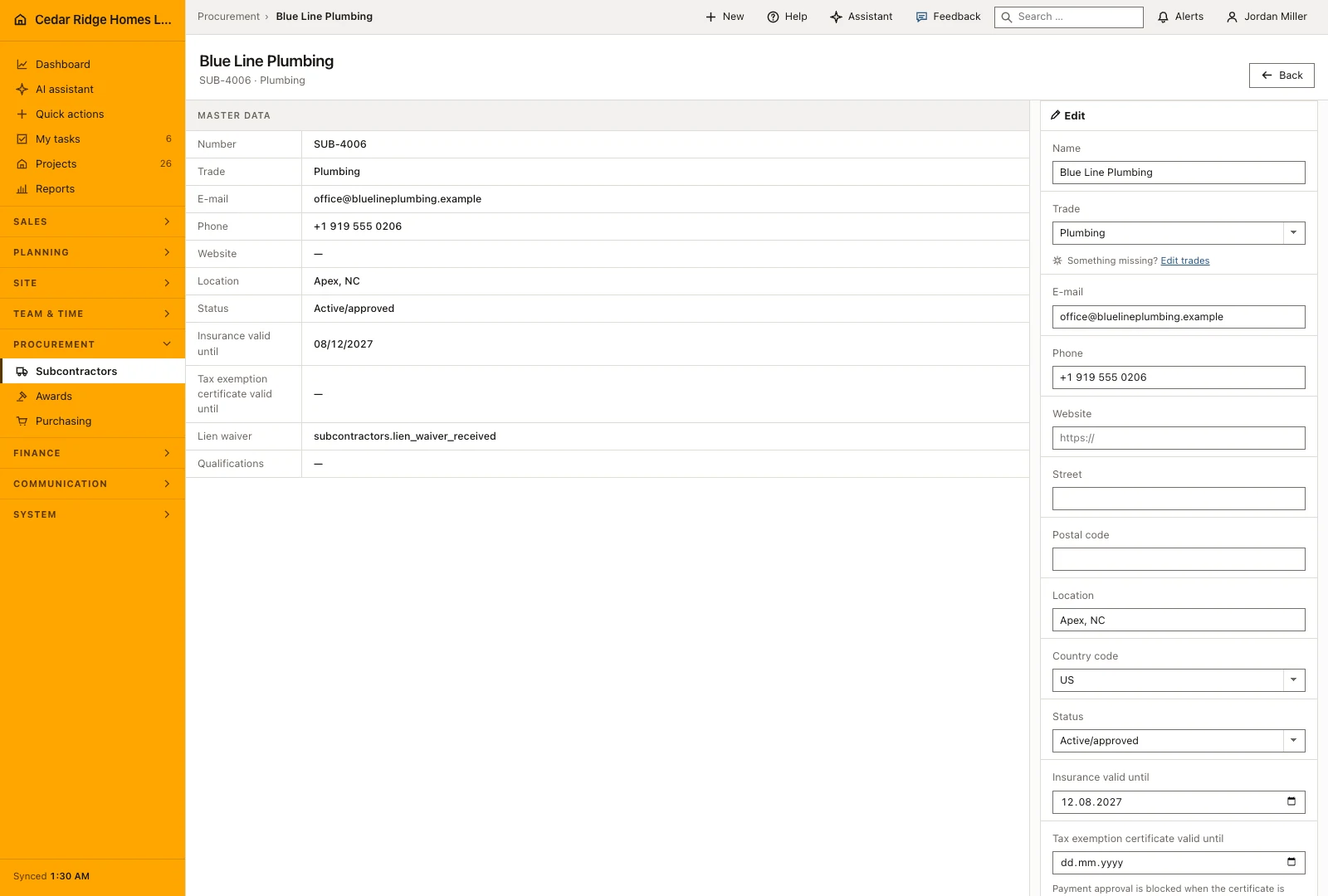
Two things have to exist before a purchase order can be written: the firm you are ordering from, kept as a supplier or subcontractor record, and an account carrying purchasing.manage. That right is what the write gate asks for on every purchasing route, while finance.view alone opens the list read-only. The shipped roles split it the way a building company does, so Einkauf und Vergabe and Bauleitung both order while Büro und Rechnungswesen does not.
The supplier record also decides whether money will ever leave for that firm. Payment release reads the validity of the tax exemption certificate and the state of the lien waiver, and holds the document back as soon as one of them is missing or expired. Fill both in while the order is being placed rather than on the day the payment run drops the invoice. The DIN 276 catalog is the third piece: without a cost group an order has no place in a project budget.
Writing a purchase order with line items and a cost group
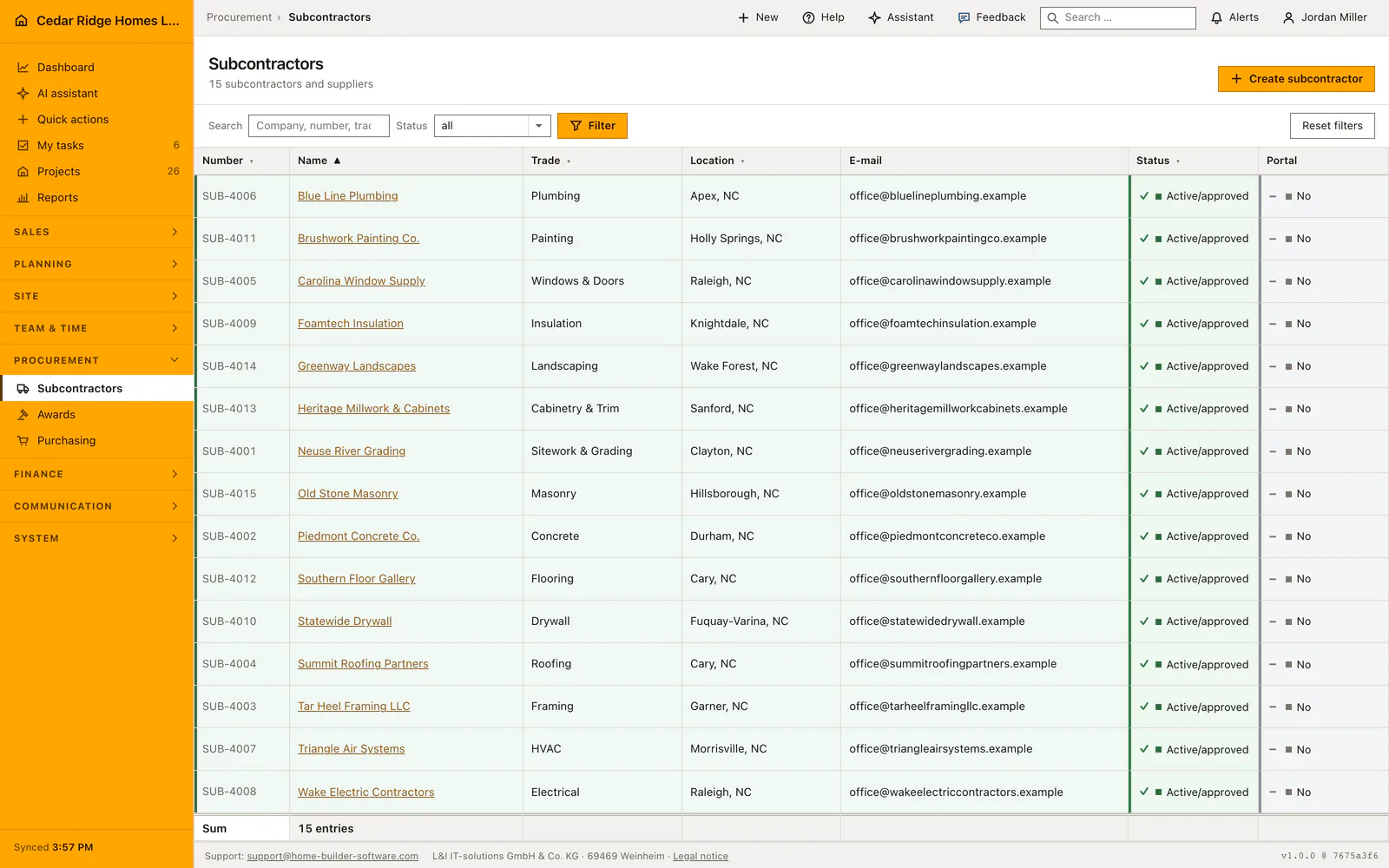
The create form asks for project, supplier, a title, a cost group, an opening status and a delivery date, then a line item table with description, cost group, quantity, unit and unit price. The number comes from the company sequence in the form B-2026-0142. Once lines exist their total replaces the header amount, and a cost group that is the same across every line moves up into the head by itself.
An order that came out of an awarded trade is better started there: opened with the winning bid attached, the form arrives with project, supplier, cost group and price already filled in, and the order stops drifting onto a different cost group than the package it pays for. Older orders reduced to a header amount are not lost either, because appending positions afterwards recalculates the amount from those lines.
Chasing delivery dates and booking goods receipts
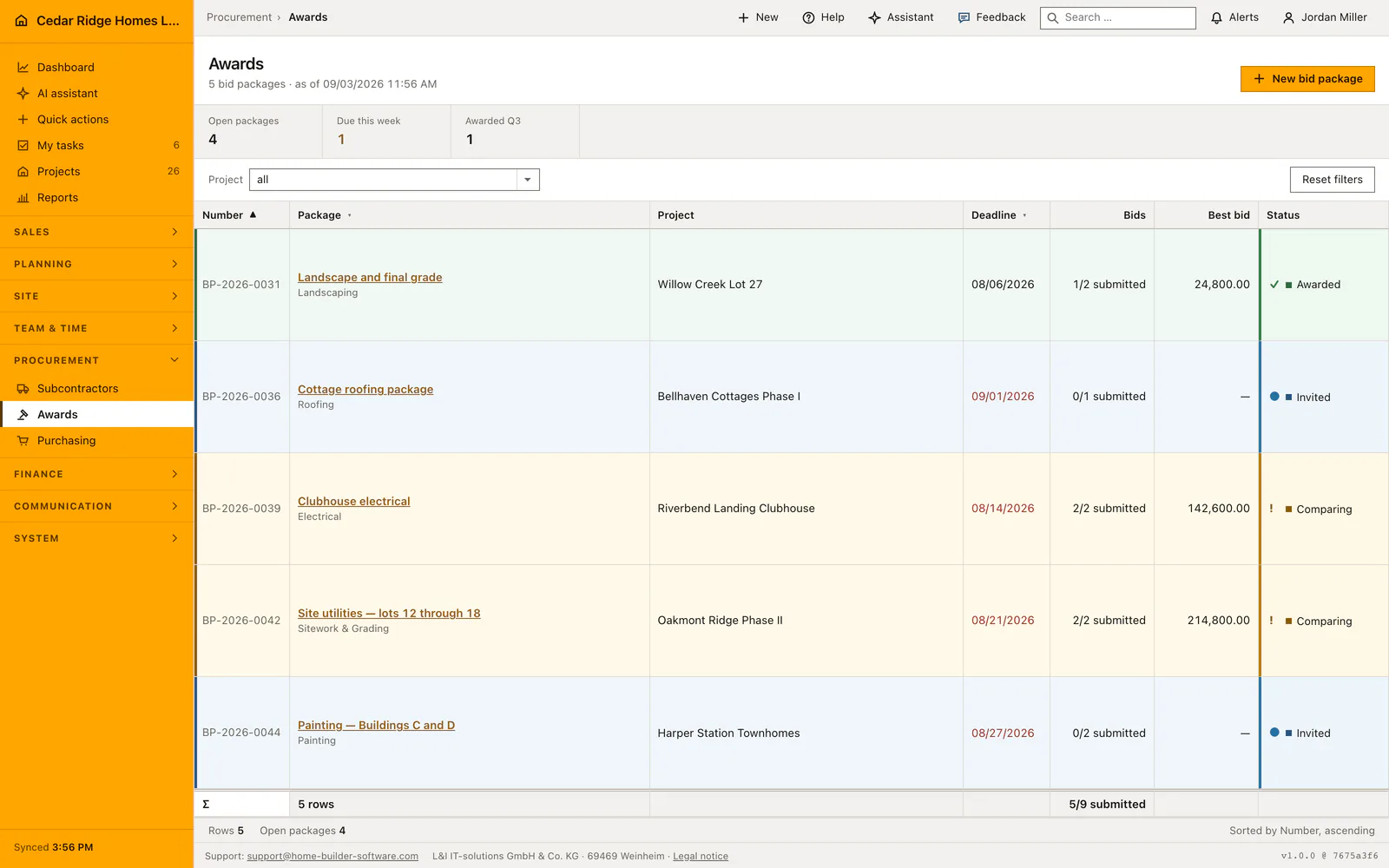
The metric strip counts over the filtered set: open order value, deliveries falling in the running calendar week and the number of orders already completed. A passed date on an order that is neither delivered, completed nor canceled turns red and carries the word overdue beside it, so the signal does not rest on color alone. Free-text search reaches order number, title and supplier name, the table pages at twenty-five rows, and the CSV export writes the filtered set.
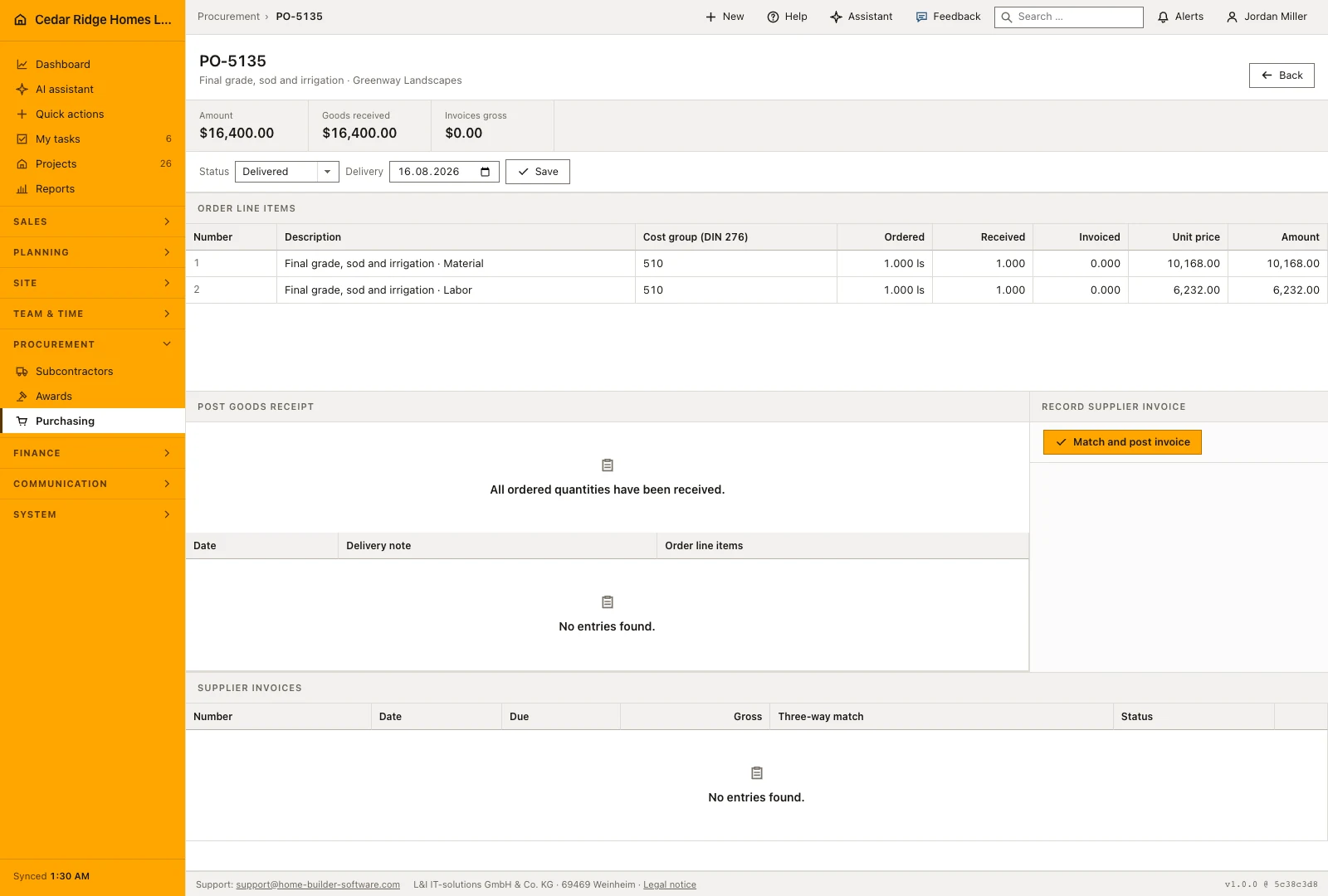
When the lorry arrives, the goods receipt takes the receipt date, the delivery note number and a quantity per line. More than the quantity still outstanding is refused inside the transaction. The status then follows by itself: part of the quantity gives part delivered, the last outstanding unit gives delivered. Recording the supplier invoice afterwards asks for the supplier document number, invoice and due date, tax rate, then a quantity and price per line.
Match exceptions, blocked payments and the supplier payment run
The three-way match compares each invoiced line against the ordered unit price and against the quantity received but not yet invoiced. Whatever sits above either lands on the document as an exception, and payment release refuses it while naming the reason. A clean document can still hang: when the subcontractor's certificates are not in order the release stops on the message about the exemption certificate and the lien waiver.
The payment run occupies a page of its own rather than a bar above the list. At the chosen cut-off date it shows the invoices it would settle, the blocked ones beside them, the count and the total, and asks once more before executing. Each step leaves its own audit record, from the created order through the booked receipt and the approved supplier invoice to the completed run.
What purchasing passes on to budget, awards and finance entries
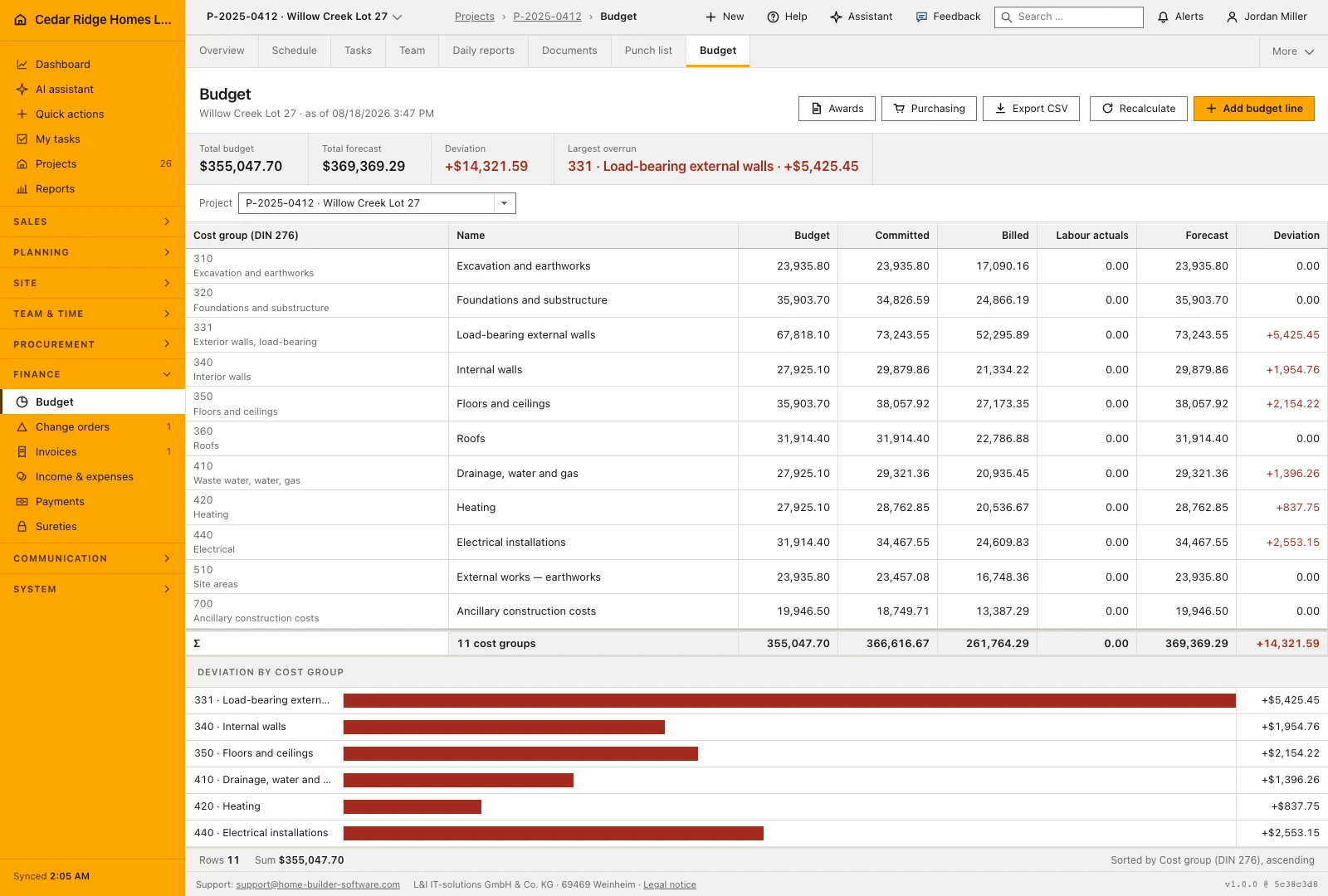
After every write the budget of the affected job is recalculated. Orders count as a commitment while they stand in sent, confirmed, part delivered or delivered. Where the money lands is decided by the cost groups on the positions; the head is only consulted when there are no lines at all. A cost group nobody planned gets a budget line of its own instead of staying invisible.
A recorded supplier invoice creates a finance entry of the purchase type, numbered EK, tied to the order, the due date and the cost group. Approval marks that entry booked, the payment run marks it reimbursed and writes a payment under a ZL number referencing the run and the supplier document. The award register upstream and the budget page downstream both link into this list.
Example of a purchase order with goods receipt and three-way match
Cedar Ridge Homes orders windows for Willow Creek Lot 27 from Carolina Window Supply. The buyer opens the create form, picks the project and the supplier, writes the title window package lot 27, sets cost group 330 and a delivery date of 09/04/2026, and enters two lines: fourteen windows at $685 and two exterior doors at $1,240. The software totals the lines to $9,590 plus $2,480, writes $12,070 into the head, and reserves the number PO-5136 from the company sequence. After release the order stands in sent, and the tile for open order value rises by exactly those $12,070.
Ten windows arrive on 08/28/2026; the goods receipt takes the delivery note number and the quantity, and the status moves to part delivered. A second receipt books the last four windows and both doors, and the order reads delivered. The supplier invoice then bills the fourteen windows at $705 instead of the ordered $685, and the three-way match flags the $280 difference as an exception, so payment release refuses the document and names the price deviation. Carolina Window Supply sends a corrected invoice over $12,070, the exception disappears, and the next payment run settles the amount and leaves its audit record.
Construction purchase order software: checks before saving
Booking a goods receipt above the quantity still outstanding on a line is rejected inside the transaction, so received quantity can never pass ordered quantity.
A supplier invoice may carry each order line only once, otherwise two part invoices would be compared against the same untouched received quantity.
The supplier document number is unique per supplier and company, which stops the same invoice from being recorded twice.
Payment release requires a clean match plus a valid tax exemption certificate and a lien waiver in order on the supplier record.
Filter and status values are read against a fixed list; an unknown value in the address bar is ignored rather than passed on.
Construction purchase order software: common mistakes
An order without a cost group on the head and without cost groups on its lines never reaches the project budget. Nothing on the list says so; the amount is simply missing from the committed column.
Adding positions to an order that only carried a header amount replaces that amount with the total of the lines. Compare the figures against the supplier's confirmation before saving rather than after.
The payment run settles everything approved and due at the cut-off date, not a selection. To pay less, move the cut-off date back instead of hoping to untick a row on the confirmation page.
The product page describes the same module from the business side, with the decisions it supports and the modules it connects to.
See the product pageFrequently asked questions
Which stages does a purchase order follow?
Orders move through draft, approval, sending, acknowledgement or confirmation, partial delivery, delivery and completion. Cancellation is also recorded.
How are late deliveries shown?
A passed delivery date remains red and marked overdue until the order is delivered.
What does construction purchase order software track?
It tracks the project, supplier, order lines, quantities, unit prices, cost groups, delivery date and purchasing status. Home Builder Software also records partial goods receipts and connects committed orders to the project budget.
Can I record partial construction deliveries?
Yes. Record a goods receipt with its date, delivery note and quantities for each line. Quantities above the outstanding amount are refused, and the order moves to partially delivered or delivered according to what has arrived.
When does a purchase order count as committed job cost?
Orders in sent, confirmed, partially delivered or delivered status contribute to committed cost. Cost groups on the line items determine the budget allocation; an order without lines uses its header cost group.
Configuring this part for your own company?
Describe the sequence you follow today and the result you need at the end of it. We can walk through the settings that produce it.